
Opening DCPs#
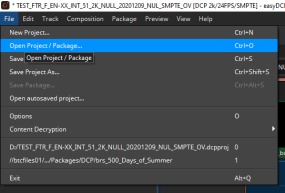
With the function for opening packages the easyDCP Creator provides a powerful feature to apply changes to existing DCPs fast and easily. With this function you are able to open your own DCPs or third party DCPs and deploy any changes e.g. adding subtitles, adding sound tracks, adding and rearranging reels and so forth.
Editing an opened DCP#
An opened unencrypted DCP can be edited just like a DCP that is built from scratch. Some restrictions apply on encrypted DCPs (see below). It is also possible to save the opened DCP and the deployed changes as a Project (*.dcpproj) in the easyDCP Creator. From the edited DCP, you can then generate a new DCP or a supplemental DCP.
Saving an opened package#
When you have opened a package and just make changes on the metadata of the package, you don’t have to generate a new package, you can also just save your changes to the existing one. Changes of the metadata include the offset, duration and annotation text of reels, rearranging, deleting and adding reels, renaming, deleting and adding compositions. To save the changes, choose “Save Package” in the file menu. If saving is not possible and re-encoding of the whole DCP is necessary, an error message will appear.
When saving the DCP, new UUIDs for all compositions and reels and the packing list will be generated. Thus, the saved DCP will be distinguished from the original by D-Cinema servers. If you saved an encrypted DCP, the DCP-Digest (*.dcpdig) file will be overwritten. Old KDMs for this DCP won’t work anymore, new KDMs need to be generated.
If you change the Tracks of the package, e. g. applying a color transformation or add new Tracks, you have to generate a new DCP or a supplemental DCP using the button “Generate Package…”.
Supplemental DCPs#
Generating a feature movie is a time expensive procedure. If you’re just adding subtitles or an additional sound track to an existing movie, easyDCP Creator provides a solution saving you a lot of time. You can generate a supplemental DCP. A supplemental DCP is a DCP, which enhances or modifies an existing DCP by providing just the changes and using the Tracks of the original DCP as references. Hence you don’t have to build a whole DCP when just adding material to an existing one. Because a supplemental DCP amends an existing DCP, both the original DCP and the supplemental DCP have to be ingested on a D-Cinema Server to playback the compositions of the supplemental DCP.
To generate a supplemental DCP with easyDCP Creator you have to open a DCP and mark the original track and subtitle files as references (supplemental). For that, you have to click with the right mouse button on the Track and select “Supplemental -> This Track” in the displayed menu:
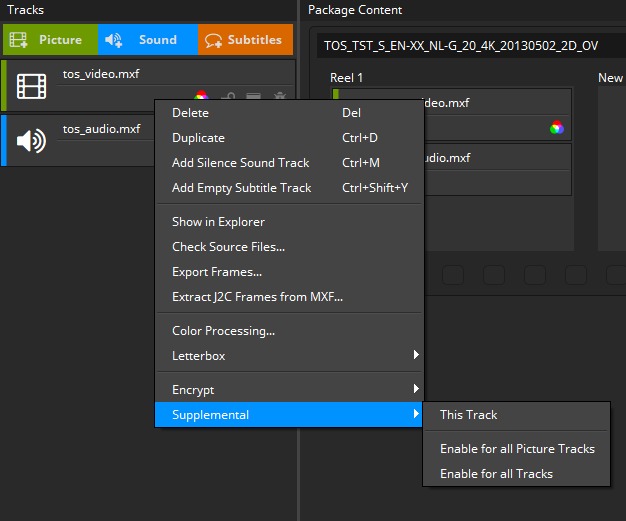
Then new compositions and new Tracks can be added and changes at existing compositions can be applied.
By clicking on the “Generate Package…” button the supplemental DCP will be generated. The difference to a normal DCP is, all Tracks marked as reference are not packed into the supplemental DCP, they are only referenced by CPL(s). This saves disk space and time during the generation process of the DCP. With the easyDCP Creator it is even possible to open and edit supplemental DCPs and generate further supplemental DCPs to them.
Opening encrypted DCPs#
Opening encrypted DCPs is a feature of the easyDCP Creator only. When you open an encrypted DCP where you also have the corresponding Digest file (*.dcpdig), you can perform any changes you want on the DCP. This way you can open and modify encrypted DCPs you have built yourself. Without the Digest you can’t change the DCP. If you have a KDM for the DCP you can view its content in the preview window. An opened encrypted DCP shows a closed lock on the encrypted Tracks, indicating that you have no access to this content.
If you have the DCP-Digest file (*.dcpdig) or a KDM for the DCP, you can either load it via the file menu or directly drop it onto the track manager to gain access to the encrypted content.
After you have loaded a KDM or Digest, an opened lock is shown with the Tracks denoting your access to its content. With a Digest file loaded, you can apply any changes on the DCP and save it or generate a new or supplemental DCP. Without a Digest, you can only generate supplemental DCPs.
When generating a supplemental DCP from an encrypted DCP, new KDMs for the supplemental DCP have to be generated.
Validator#
The package validation module was introduced with easyDCP Creator 3.4. It can be used to automatically search for a range of potential issues in a DCP. The validation is split up into many individual tests. Tests are executed one after the other. Some tests only take a split second (for instance: check if all files exist) while others may take a while (for instance: check if all JPEG 2000 images can be decoded).
Once a test was executed, it gives a result that is either Success, Warning or Failed. When selecting a test, more details can be found in the bottom section of the validation dialog. A tree of events will describe what the test has done and each entry in the tree can in turn be selected to see its details in the dark-grey text edit below. It is often not possible to foresee whether an issue will cause the DCP to be rejected by a cinema server or another tool in the production chain. For this reason we encourage the user to even take warnings seriously.
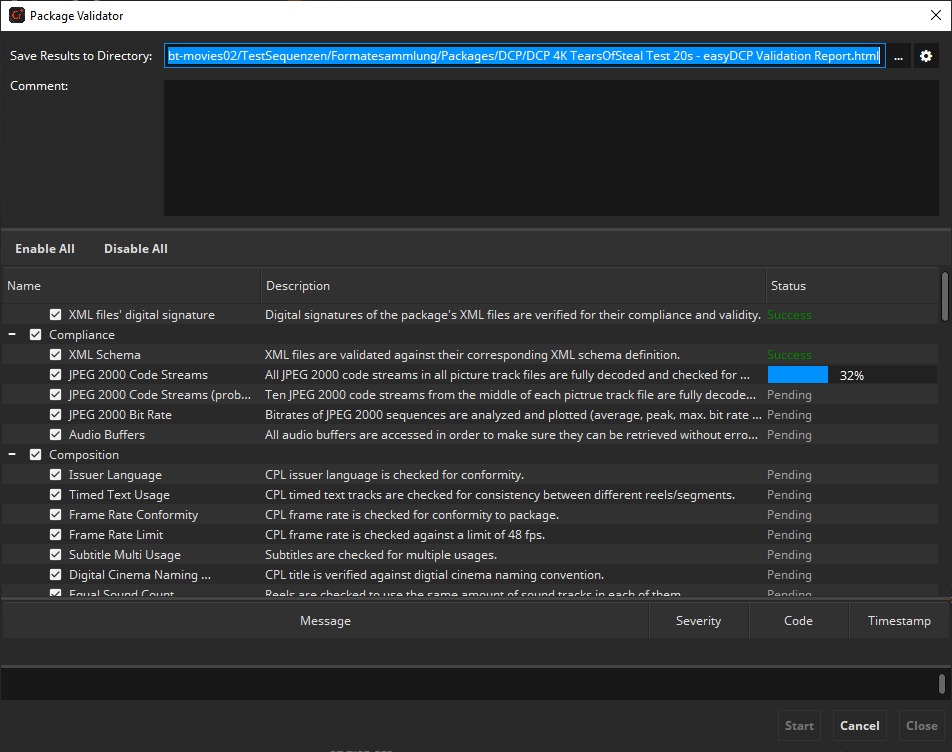
The result of a validation run is always stored as a report in HTML format. By default, the file will be named after the folder that contains the DCP and be located next to it. Also, the overall test result will be included in the file name:
DCP: C:MyDcpsAliceWonder_FTR-1_S_EN-LAS_US-13_51_2K_DI_20060607_TDC_OVReport: C:MyDcpsAliceWonder_FTR-1_S_EN-LAS_US-13_51_2K_DI_20060607_TDC_OV – easyDCP Validation Report (Success).html
By clicking the cogwheel icon next to the “Save Results to Directory” field, the default behavior can be changed so that the file be located inside the DCP directory and/or that the overall validation result not be included in the filename.
DCP: C:MyDcpsAliceWonder_FTR-1_S_EN-LAS_US-13_51_2K_DI_20060607_TDC_OVReport: C:MyDcpsAliceWonder_FTR-1_S_EN-LAS_US-13_51_2K_DI_20060607_TDC_OVAliceWonder_FTR-1_S_EN-LAS_US-13_51_2K_DI_20060607_TDC_OV - easyDCP Validation Report.html
The validation report is separated into seven sections:
The validation report is separated into seven sections:
General Information – contains top-level metadata on the package, the test result and the computer and easyDCP version where the validation was carried out. Custom annotations that the user entered into the validation dialog’s “comment” field will also be added to this section.
Composition Playlists – lists technical properties (such as duration, resolution, package type, JPEG 2000 profile, audio layout, etc.) individually for each composition.
Quality Report – contains all the test results and details in an interactive view.
Recommendations – contains all the test results that are compliant to the standard but can cause issues in cinemas.
JPEG 2000 Bitrate Analysis – contains an interactive plot of the bitrate in Mbit/s over time for each CPL. Additionally, some statistics such as peak and average bitrate or the time code of the largest frame are stated.
Files – lists the content of each XML file as well as the metadata of each MXF file in the package. If the package is a supplemental package (version file - VF) and the original version (OV) was also loaded, both packages’ files are listed.
Directory Snapshot – lists all files (including those that don’t belong to the package) within the folder or any subfolders of the package, including the file’s size in Bytes and date of its last modification. Paths are stated relative to the package’s root folder so that names of the user’s local or network repository are not disclosed.
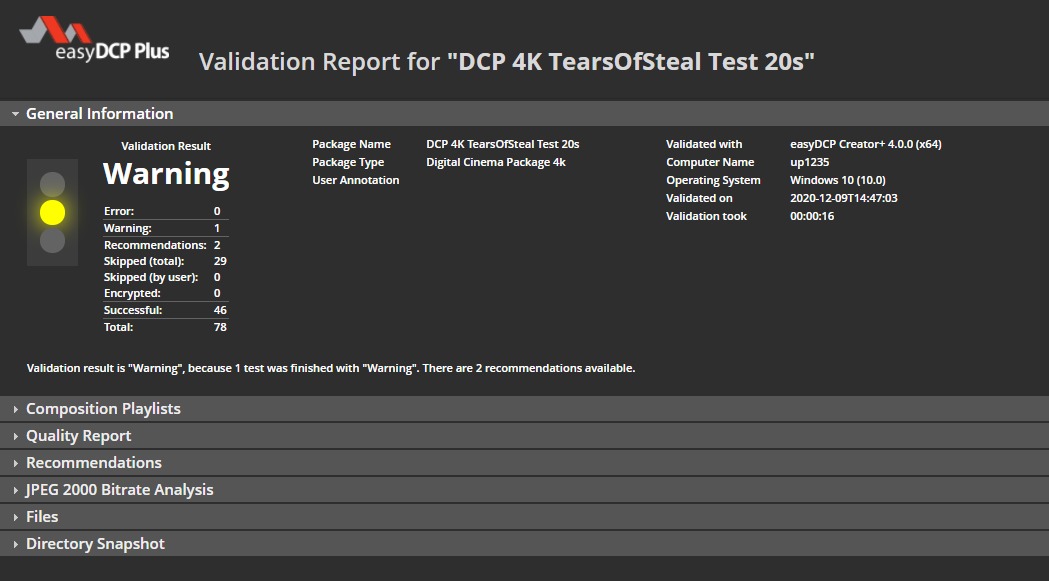
The overall result of the validation is
Failed – if at least one test found an error.
Warning - if at least one test found a warning or has been deliberately disabled by the user (by clicking the check box next to the test in the validation dialog), and no test found an error.
Success – if all tests were executed and none of them found any potential issues (warnings or errors).
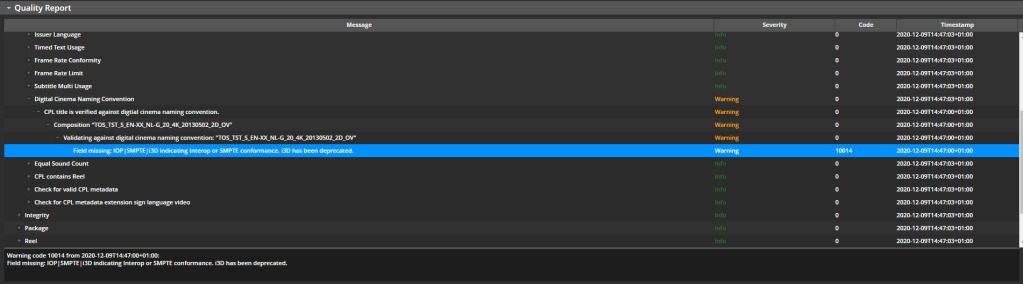
The quality report shows the results and details of all tests. When selecting a test, details are shown in the dark grey box on the bottom. In the below example, the test result is a warning, because the tests was deliberately disabled by the user by deselecting it before the start of the validation.
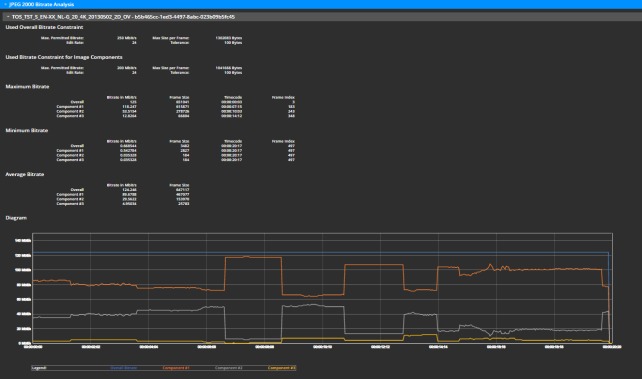
The Bitrate Analysis tab gives information on the JPEG 2000 bitrate. Every DCP or IMP is subject to a maximum bitrate that should never be exceeded. The maximum is typically 250 Mbit/s for DCPs, but can be higher for high-bitrate DCPs. The maximum bitrate is independent of the resolution or whether the movie is in 2D or 3D. easyDCP Creator will infer the maximum bitrate based on the package type and JPEG 2000 profile.
JPEG 2000 is a highly data-dependent image compression scheme, though. If a particular image is easy to compress, e.g. because there are not a lot of details in it, then the maximum bitrate will not be reached. Only images with many details (or a lot of noise) will have to be capped in order not to exceed the data rate. The bitrate computed by easyDCP is based only on the size of the decrypted JPEG 2000 file (i.e. without MXF overhead) and is converted from bits to Megabits using 10^3 (1000) as demanded by the specifications - and not 2^10 (1024).
Starting with easyDCP 3.7.0 the bitrate analysis also shows the bitrates for each of the three components. For DCPs the component bitrate is limited at 200 Mbit/s. Since this can lead to issues on some cinema servers, the validation will show a warning between 190 to 200 Mbit/s for a component.
The diagram plots the bitrate over the time for each CPL. The plot is zoom-able via the mouse wheel and can be moved left or right by dragging it with the left mouse button pressed.
The validation can also be triggered from the command line. This way it is also easy to batch-validate an existing collection of DCPs.
Below is an example of a Windows Batch file for validating all DCPs in a given folder:
@echo off
pushd \\networkstorage\MyDcpRepository
set EasyDcpBin=C:\Program Files\Fraunhofer IIS\easyDCP Creator+ 4.0.0\bin\easyDCP
Creator+.com

for /f "tokens=*" %%D in ('dir /S /B /A:-D assetmap*') do (
    echo Validating %%D
    echo.
    "%EasyDcpBin%" "%%D" -validate -o C:\\Reports
    echo.
)
popd
For more details on how to use easyDCP Creator from the command line, please refer to chapter 15.
Merge CPLs#
easyDCP Creator can merge CPLs from other DCPs or complete other DCPs into the currently opened project. Via Package => Merge CPLs the file, either the ASSETMAP or the CPL XML file, can be selected. The CPLs of the selected package will be added to the active project. In case of matching track files (e.g. when adding a VF to the OV) the track files are automatically reused.
There currently are some limitations for the import process:
Project types have to match: you can’t import an IMF package into easyDCP Creator
Framerates of the packages have to match